2026-10-17
Ellanse vs. Fillers: What Keeps Added Volume in Place
Ellanse is a filler in the broad sense, but unlike hyaluronic acid fillers, its PCL microspheres encourage your own collagen to form as the gel is absorbed.





a. Broadly speaking, Ellanse is a type of filler, but the way it maintains volume differs from hyaluronic acid (HA) fillers, which are what most people mean by 'filler.' b. With HA fillers, the injected gel itself fills the volume. With Ellanse, while the initial gel is absorbed, the body's own collagen is encouraged to settle around the PCL microspheres. c. Ellanse is not broken down by hyaluronidase, the enzyme used to dissolve HA fillers. That's why we first assess the cause and depth of the wrinkles or hollowing, as well as skin thickness, before deciding whether to proceed.
Written by Park So-hyun, Director, Samsung BNS Clinic | References: Samsung BNS Clinic website pages 'Collagen Stimulation Injection,' 'Fillers,' and 'Post-Treatment Precautions'; academic literature (de Melo et al., 2017; Christen and Vercesi, 2020)
Hello, I'm Park So-hyun, Director of Samsung BNS Clinic.
Some people who are looking into Ellanse first want to know whether Ellanse is a filler too.
Both Ellanse and hyaluronic acid fillers are materials injected beneath the skin. The difference lies in whether the injected material itself becomes the volume, or whether, while the initial gel is absorbed, it encourages your own collagen to form in that same space. This difference also changes how results are monitored over time and what to consider when planning treatment.
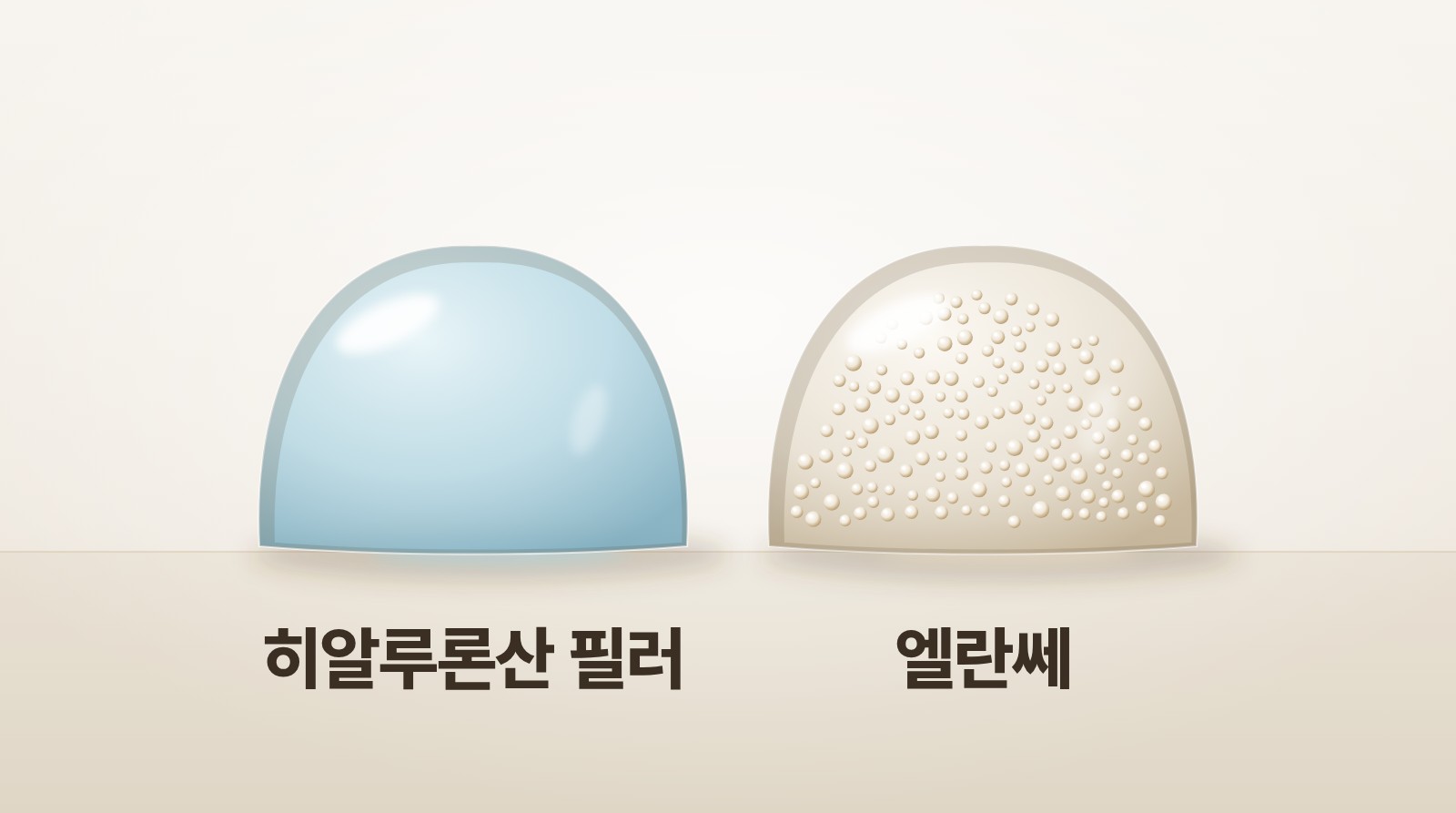
On the left is a processed hyaluronic acid gel; on the right is Ellanse, which has PCL microspheres mixed into a CMC gel. This is an illustrative diagram and does not show the actual product or treatment material.
Today, I'll go over the differences between Ellanse and hyaluronic acid fillers, starting with the underlying principles, and explain the criteria we use in clinic to decide whether a treatment is appropriate.
1. Is Ellanse a filler too?
'Filler' literally means 'a substance that fills.' Broadly speaking, any material injected beneath the skin to correct hollowed areas or deepened wrinkles is called a filler.
Ellanse is also a medical device injected beneath the skin. So, broadly speaking, Ellanse also falls under the category of fillers.
In the clinic, however, when people say 'filler,' they usually think of hyaluronic acid (HA) fillers. The 'filler' we're comparing side by side with Ellanse today is also an HA filler.
Even within the same 'filler' category, the mechanisms that keep the added volume in place are different.
2. With HA fillers, the gel itself becomes the volume
Hyaluronic acid is a substance naturally found in our skin, and it has the property of holding water. The hyaluronic acid used in fillers is processed into a gel form so it can remain in the body for a longer period.
Because the injected gel directly fills the hollowed area and shapes it, it's relatively easy to check and adjust the result right after injection. Over time, the gel is gradually broken down and absorbed by the body. How long the results last can vary depending on the product, the treatment area, and the individual's skin condition, and additional treatments may be considered when needed.
Another feature is that it can be dissolved with hyaluronidase, an enzyme that breaks down hyaluronic acid. This means there is a way to respond if the shape needs to be adjusted or if an unexpected reaction occurs.
With HA fillers, the injected gel creates the volume, and that gel is gradually absorbed over time.
3. Ellanse divides roles between two components
Ellanse is made up of two components. A gel based on CMC (carboxymethyl cellulose) makes up about 70% of the volume, and PCL (polycaprolactone) microspheres evenly mixed within it make up about 30%. The microspheres are roughly 25–50 μm in diameter, thinner than a strand of hair, and have smooth, round surfaces.
Role 01 / 02 · CMC Gel (CARRIER GEL)
Immediately after injection, it fills the volume and shapes the area. This gel is gradually absorbed by the body over roughly 6 weeks to 3 months.
Role 02 / 02 · PCL Microspheres (MICROSPHERES)
While the gel is being absorbed, the microspheres stimulate the surrounding tissue, prompting fibroblasts to produce collagen. The newly formed collagen settles between the microspheres, and the microspheres themselves are gradually hydrolyzed over time, ultimately breaking down into carbon dioxide and water.
It's easiest to understand if you imagine the microspheres acting as a kind of scaffold once the gel has left, with your own collagen forming around them.
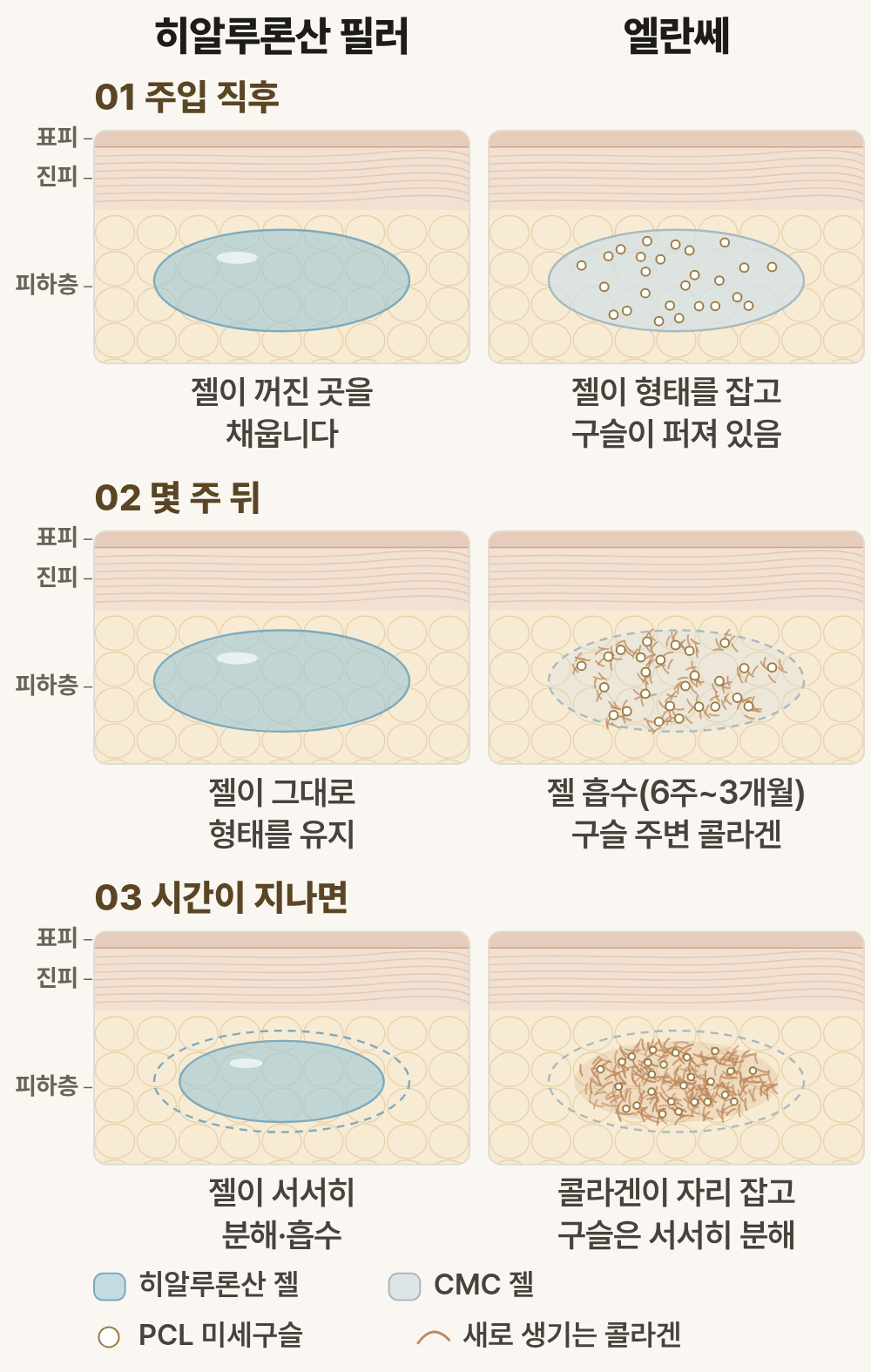
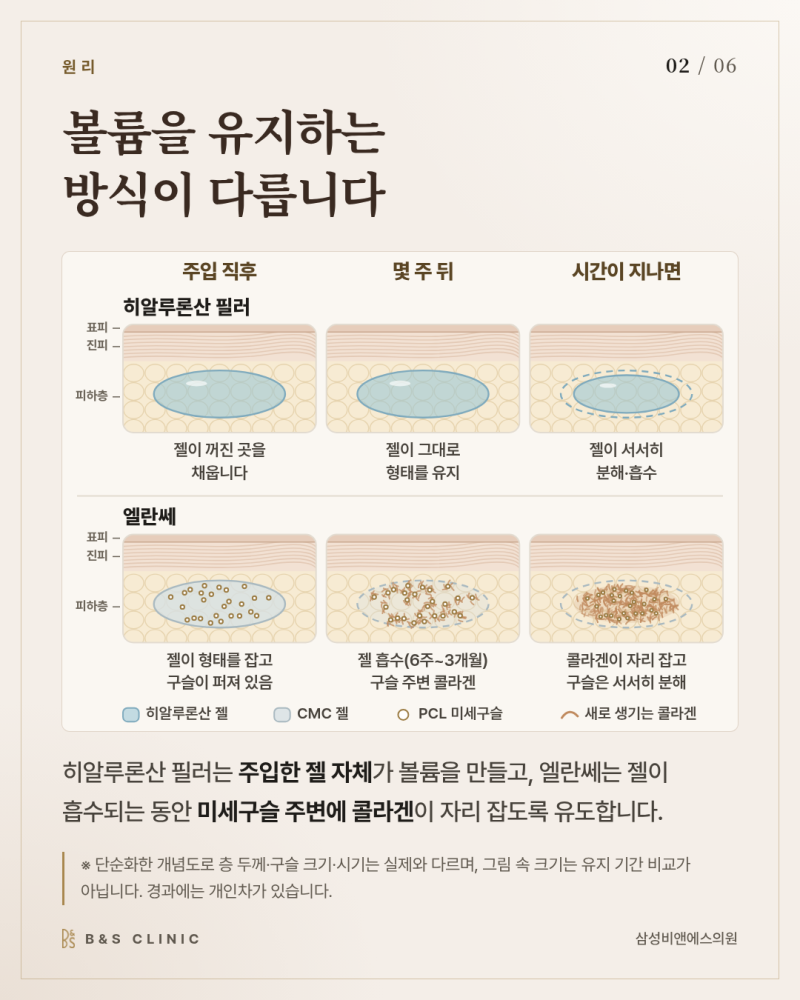
This is a simplified conceptual diagram of how HA fillers and Ellanse progress. Layer thickness, bead size, and timing differ from reality, and results vary between individuals. Both materials are gradually absorbed and broken down over time, and the sizes in the diagram are not meant to compare how long each one lasts.
Ellanse works by encouraging your own collagen to settle in place while the initial gel is absorbed.
4. The progression over time also differs
With HA fillers, the injected gel is the volume itself, so the result right after treatment serves as the baseline for judging how things will progress. After that, the result gradually changes depending on how quickly the gel is absorbed.
Ellanse is a little different. Right after injection, the gel shapes the area, but over the following weeks to months, gel absorption and collagen formation overlap. How much collagen forms varies from person to person depending on age, skin thickness, and overall health, so even with the same amount injected, the results may not look identical.
For this reason, academic literature notes that Ellanse does not require overcorrection (deliberately overfilling from the start), and recommends particular caution in areas where the skin and subcutaneous tissue are thin. The amount and area to inject are decided during consultation, taking these points into account.
Duration is also difficult to express as a single number. Ellanse comes in several types based on how long the microspheres take to break down, and even with the same product, the course varies depending on the area and the individual's collagen response. Also, since Ellanse is not a permanent material, the changes may gradually fade once the microspheres have broken down and time has passed.
Don't judge by the immediate result alone. With Ellanse, how it looks right after treatment may differ from how it looks a few weeks later or beyond. Rather than drawing conclusions from the results immediately after treatment, it's important to check the outcome over a set period of time.
5. The ability to dissolve with enzymes also differs
HA fillers can be dissolved with hyaluronidase. Ellanse, on the other hand, is made of components other than hyaluronic acid, so it cannot be dissolved with hyaluronidase. The collagen that forms afterward also becomes part of your own tissue.
That's why it's important to thoroughly assess the treatment area, depth, and amount before the procedure. Ellanse is injected into the subcutaneous layer or the deep layer over the periosteum, not into shallow layers like the dermis. Injecting too superficially or concentrating too much in one spot can cause palpable lumps (nodules), so caution is needed.
For the same reason, Ellanse is not recommended for the lips, the glabella (between the brows), or the area around the eyes, including the eyelids and under-eye area. The skin there is thin with little underlying fat, which raises the risk of the product showing through or forming nodules. For these areas, we consider other options.
Before deciding where and how much to inject, we first confirm whether this approach suits your face right now.
6. Even with the same nasolabial folds, we start by separating the causes
One of the most common reasons people consider Ellanse or fillers is nasolabial folds. However, even when nasolabial folds look deep, the reasons differ from person to person. Broadly, they can be grouped as follows.
Cause 01 / 03 · Volume Loss (VOLUME)
This is when volume at the front of the cheeks or around the nasolabial area has decreased, creating a hollow shadow. In this case, an injectable treatment that restores volume, such as Ellanse or a filler, may be considered.
Cause 02 / 03 · Lines Set into the Skin (LINE)
This is when lines have become etched into the skin itself from repeated folding over a long period. Even when volume is restored, the lines may still look visible, so we separately look at methods that target the lines themselves, such as the Juvgen autologous dermal regeneration procedure.
Cause 03 / 03 · Midface Sagging (SAGGING)
This is when midface tissue has descended, making the area above the nasolabial fold look heavier and the folds more prominent. In such cases, we sometimes consider approaches that address the sagging, such as thread lifts or lifting devices, before filling treatments.
In real faces, these three often appear together, and bone structure and habitual expressions can also play a role. So even when nasolabial folds are your main concern, we don't look at the fold line in isolation. After distinguishing volume loss, fine lines, and sagging, we set priorities for what to address first.
I believe identifying what to look at first in your current face is more important than adding multiple treatments.
7. Ellanse vs. hyaluronic acid fillers at a glance
This isn't a comparison of which is better; it's a side-by-side table showing how the ingredients and mechanisms differ.
Category | Hyaluronic Acid Filler | Ellanse |
Main Ingredients | Hyaluronic acid (processed gel) | CMC gel approx. 70% + PCL microspheres approx. 30% (by volume) |
What Creates the Volume | The injected gel | Initially the gel; afterward, collagen forming around the microspheres |
Over Time | The gel is gradually broken down and absorbed | The gel is absorbed over roughly 6 weeks to 3 months; the microspheres are gradually hydrolyzed afterward |
Breakdown Enzyme | Can be broken down with hyaluronidase | Cannot be broken down with hyaluronidase |
Injection Layer | Varies by area and purpose | Subcutaneous layer or the deep layer over the periosteum |
Lips, Glabella, Periorbital Area | Considered depending on product and area | Not recommended |
The ingredient ratios, absorption timing, injection layers, and areas not recommended for Ellanse are summarized based on academic literature (de Melo et al., 2017; Christen and Vercesi, 2020). These are general differences in composition and mechanism and do not indicate superiority or differences in duration; both materials are gradually absorbed and broken down over time. Actual suitability depends on individual conditions.
8. What to know before and after treatment
Ellanse is also an injection procedure in which a needle or cannula enters the skin. After treatment, depending on the individual, swelling, bruising, redness, pain, or tenderness when pressed may appear. These usually subside over time, though the severity and duration vary.
Please let us know right away about these reactions. Rarely, palpable lumps (nodules), inflammation, or infection can occur. Also, although rare, as with any injectable procedure, blood vessels can become blocked or compressed, potentially leading to serious complications such as skin necrosis. If pain at the treatment site worsens, the skin changes color, or pain persists, please contact the clinic promptly. Cases of nodules forming long after treatment due to a foreign body reaction have also been reported.
Please be sure to tell us during your consultation. If you have an autoimmune disease, are pregnant or breastfeeding, are taking high-dose steroids, have uncontrolled diabetes or metabolic syndrome, have a blood clotting disorder, or have inflammation, infection, or herpes at the treatment site, the procedure may need to be withheld or postponed. It also helps us if you tell us, to the best of your recollection, about any medications you're taking, such as anticoagulants, and the type and timing of any fillers you've had before.
Whether to shape or massage the area right after injection and how to care for it afterward vary by treatment area, so we'll give you separate instructions on the day of treatment. For several days after treatment, we recommend avoiding heavy drinking, saunas and jjimjilbang (Korean bathhouses), and strenuous exercise.
Frequently Asked Questions
Q. Is Ellanse also a filler?
Broadly speaking, yes. It's classified as a filler because it's a material injected beneath the skin to correct hollowed areas or wrinkles. However, its ingredients differ from hyaluronic acid fillers, which are commonly called 'fillers,' and its mechanism differs in that collagen is encouraged to form around the microspheres while the initial gel is absorbed.
Q. I've heard Juvgen is also related to collagen. How is it different from Ellanse?
The Juvgen autologous dermal regeneration procedure separates adhered tissue within the skin and places a very small amount of hyaluronic acid into that space to stimulate collagen production. It mainly targets fine lines set into the skin. Ellanse is injected into the subcutaneous layer or deeper in hollowed areas, encouraging collagen to form around the microspheres while the gel is absorbed. Even for the same nasolabial folds, the approach differs depending on whether lines or volume loss is the main issue.
Q. For nasolabial folds, which is the right choice: Ellanse or a filler?
First, we look at why the nasolabial folds appear deep. If volume loss causing a hollow shadow is the main cause, an injectable treatment such as Ellanse or a filler can be considered. However, if fine lines set into the skin or midface sagging are also present, other approaches may be considered first or in combination. Which option is right is decided after examining your face in person.
Q. Are there areas where Ellanse is not recommended?
We don't recommend Ellanse for the lips, the glabella, or the area around the eyes, including the eyelids and under-eye area, because the skin is thin and there is little underlying fat. Ellanse is a material injected into the subcutaneous layer or the deep layer over the periosteum, so if it's placed too superficially, it can show through or form nodules.
What to Look at Before Treatment
Rather than whether it's Ellanse or a filler,
first look at the changes in your face right now
· Wrinkle pattern — whether they appear only when making expressions or remain at rest
· Volume changes — hollowed areas such as the front of the cheeks, sides of the cheeks, or temples
· Direction of sagging — whether it extends from the midface toward the corners of the mouth or the jawline
· Skin thickness and elasticity — the basis for determining injection depth and amount
· Treatment history — the type and timing of previous procedures, such as fillers or thread lifts
· Desired outcome — facial features you want to preserve
At Samsung BNS Clinic, the director consults with you first, rather than a counseling coordinator, and we decide together whether and how to proceed after examining your face in person.

Park So-hyun, Director, Samsung BNS Clinic
If you're considering Ellanse
you don't have to decide on a treatment first.
The same concern can look very different depending on whether it stems from lost volume, lines left in the skin, or tissue that has descended. That's why consultation begins with examining your face as it is now.
After looking at your wrinkles, volume, skin thickness, and the direction of sagging together, I will explain the options that can be considered in your current condition, including Ellanse and fillers.
Consultation and Booking Information
Consultation Request | Samsung BNS Clinic Official Consultation Request FormYou can submit a consultation request to Director Park So-hyun. |
Phone | 02-501-4341Office hours may vary by day, so please call ahead to confirm before visiting. |
KakaoTalk | |
Directions | 9th Floor, Samheung 2nd Building, 514 Teheran-ro, Gangnam-gu, Seoul 5-minute walk from Exit 4 of Samseong Station, Line 2 |
Website |
※ This post was written by the medical institution's operator for the purpose of providing medical information, and does not guarantee any specific treatment outcome.
※ After injectable treatments such as Ellanse and hyaluronic acid fillers, adverse reactions may occur depending on the type of treatment and individual condition, including swelling, bruising, redness, pain, nodules, inflammation, infection, and asymmetry. Rarely, complications such as skin necrosis due to vascular occlusion or compression, allergic reactions, and delayed foreign body reactions may also occur.
※ After the Juvgen autologous dermal regeneration procedure mentioned in this article, bruising, swelling, redness (which may last 1–2 months depending on the individual), temporary unevenness, inflammation, and infection may occur; rarely, complications from vascular occlusion or compression, nodules, necrosis, and allergic reactions may also occur. After thread lifts, bruising, swelling, pain, a foreign body sensation, thread migration or breakage, and asymmetry may occur; after lifting device treatments, temporary soreness, swelling, bruising, redness, and, rarely, burns may occur.
※ The ingredient ratios, absorption timing, injection layers, and areas not recommended for Ellanse are general information compiled from academic literature. Actual outcomes and duration vary depending on each person's skin condition and treatment area.
※ The representative image and cross-sectional diagrams are simplified illustrations intended to aid understanding; they do not depict actual products, tissue, or treatment results.
※ Whether a treatment is appropriate and its scope should be determined after thorough consultation and examination with your medical team, based on your individual condition.