2026-10-21
ECM Skin Boosters: What Donated Skin Goes Through Before It Becomes an Injection
A look at how ECM skin boosters are made from donated human skin, the donor screening and processing involved, and how they are regulated as human tissue in Korea.

a. ECM skin boosters such as 리투오 and 셀르디엠 (injections using acellular allogeneic dermal particles) are made by removing the cellular components from the dermis of donated human skin and then finely processing the extracellular matrix (ECM), the structural components that fill the space between cells. b. They are not classified as drugs or medical devices; they are managed as “human tissue” under the law. Because they are not approved through product-by-product reviews of effectiveness and safety, tissue banks handle everything from donor screening to processing and distribution, and clinics record which tissue was used on which patient. c. Very few public studies have been conducted in humans, so how long the effects last and any delayed reactions still need to be monitored. For this reason, we first clarify what your skin concern is and then decide whether treatment is appropriate.
Hello. This is Dr. Park So-hyun, Director of Samsung BNS Clinic.
The raw material for ECM skin boosters is skin donated by people. With this material and its management system covered in the October 2026 National Assembly audit and in the news, some of you may be hearing about it for the first time.
I believe that knowing what goes into your skin is important information to have before weighing its effects. So this article first explains where the raw material comes from, what testing and processing it goes through, and what regulatory framework governs it, followed by points to know before and after treatment.


This is an explanatory illustration showing an enlarged view of the extracellular matrix (ECM) in the dermis. The thick bundles represent collagen, the thin, wavy fibers represent elastin, and the elongated cells represent fibroblasts in your skin. It depicts the structure within the skin, not the material used in injections.
1. ECM is the component that fills the space between cells
The dermis contains cells such as fibroblasts, but most of what fills the dermis is protein and sugar components located between cells. This is called the extracellular matrix (ECM).
Collagen provides firm structural support to the skin, elastin gives it the ability to stretch and then recoil, and glycosaminoglycans (GAGs) hold onto water. Fibroblasts are the cells that produce and reorganize these components.
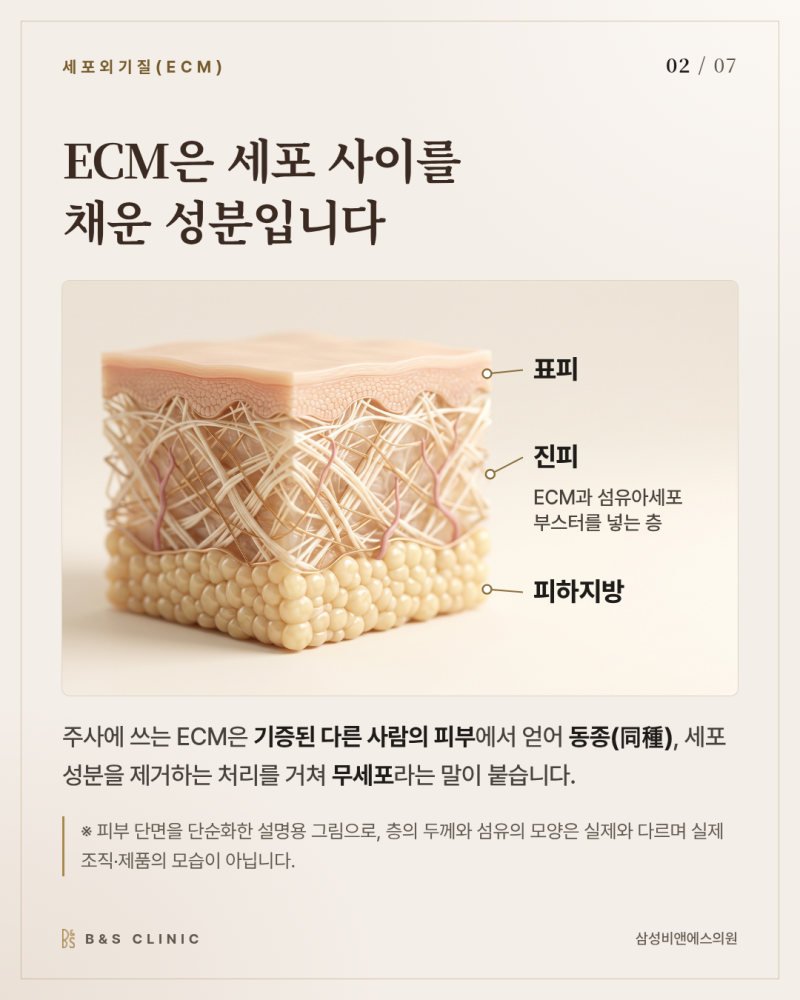
The “ECM” in ECM skin boosters refers to this structural component. However, the ECM used in injections does not come from your own skin but from the donated skin of another person. That is why product descriptions use the terms “allogeneic,” meaning sourced from another member of the same species, and “acellular,” meaning the cells have been removed.
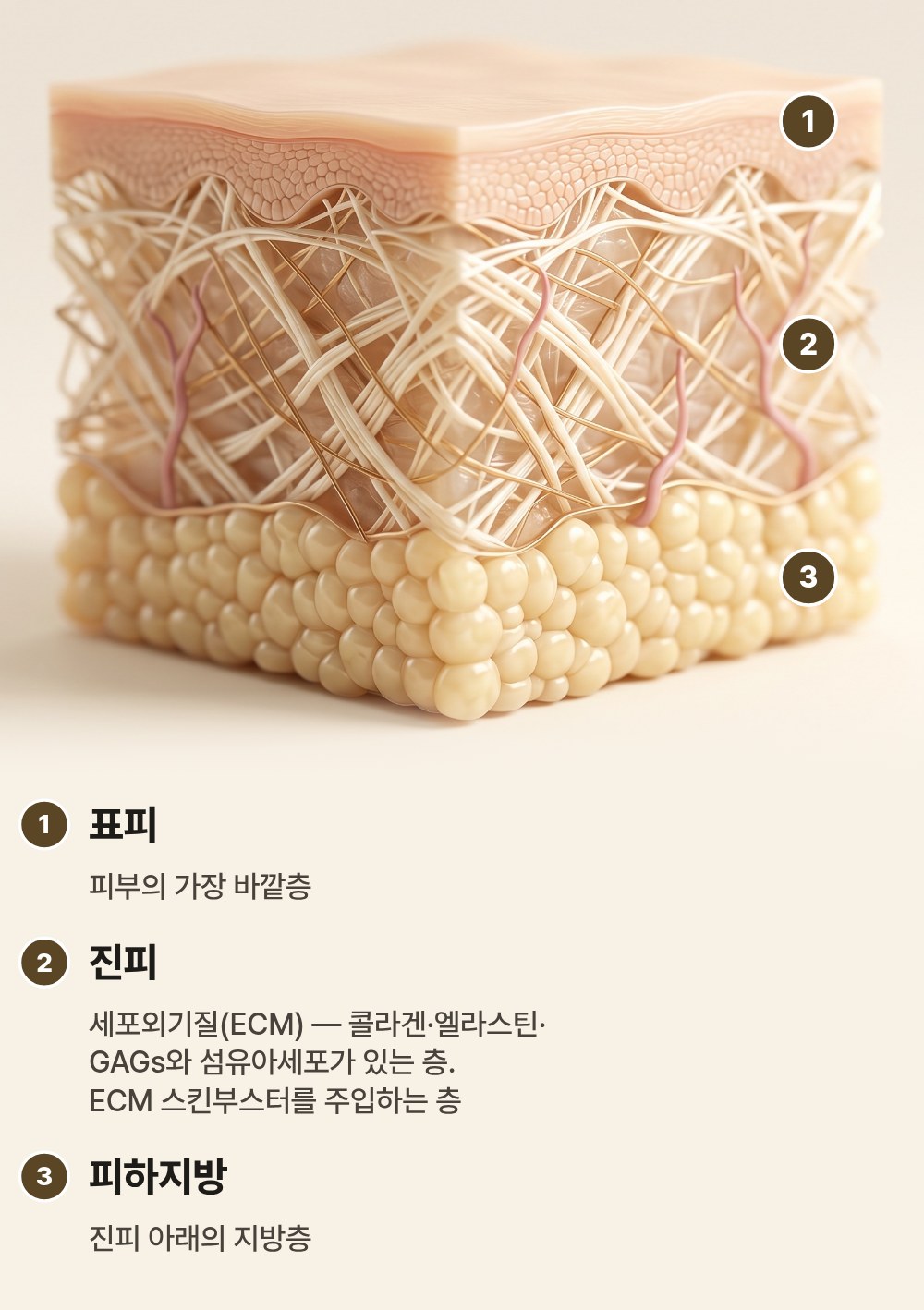
This is a simplified illustration of a skin cross-section. Layer thickness and fiber shapes do not reflect actual proportions. Of these layers, ECM skin boosters are injected into the dermis.
ECM skin boosters are made from the dermis of donated skin, not from your own skin.
2. Where does the source skin come from?
In April 2026, the Ministry of Health and Welfare stated that raw materials for this purpose are being imported and that tissue donated in Korea is not used.
Human tissue cannot be imported by just anyone. Under the law, only tissue banks may import tissue, and each tissue bank seeking to import must obtain approval from the Commissioner of the Ministry of Food and Drug Safety (MFDS) for each tissue. The Commissioner may conduct on-site inspections of overseas manufacturers that process tissue and may halt imports if there are concerns about health risks (Article 17, Act on the Safety and Management of Human Tissue, etc.).
The law also requires the package insert accompanying each product to state the country where the tissue was collected and the test results for the tissue donor (same Act, Article 15-3). Information about the raw material can be checked in the product documentation.
Documentation records which country the tissue was collected in and what testing it has undergone.
3. What screening do donors undergo?
Tissue used for transplantation must pass the judgment criteria set by law. Blood tests must be negative for hepatitis B, hepatitis C, HIV, and syphilis, and microbiological testing must show no harmful microorganisms (Annex 2, Rules on Human Tissue Safety). Imported tissue is verified through test result documentation from the exporting country, under standards equal to or higher than these.
There are also defined categories of donors who are unsuitable for tissue collection, and their tissue cannot be used for transplantation. These include cases where the time of death is unknown; infectious diseases such as sepsis or tuberculosis; leukemia or lymphoma; Creutzfeldt-Jakob disease; and cases where the donor received chemotherapy or immunosuppressants within three months before donation (Annex 1, same Rules). In addition, tissue cannot be distributed or transplanted if the cause of death is unclear, if the donor had a degenerative neurological disease such as dementia, or if there is a risk of cancer cells spreading (Article 9 of the Act).
4. Cells are removed, and the structural components are left behind
When another person's tissue is introduced into the body, it is mainly the cells that trigger rejection. For this reason, donated dermis undergoes a process that reduces the amount of cellular components and nucleic acids (DNA) it contains. This is called decellularization. Animal studies have also reported that the body responds differently to tissue with intact cells than to material from which the cells have been removed. However, removing cells does not mean that immune reactions or allergies cannot occur.
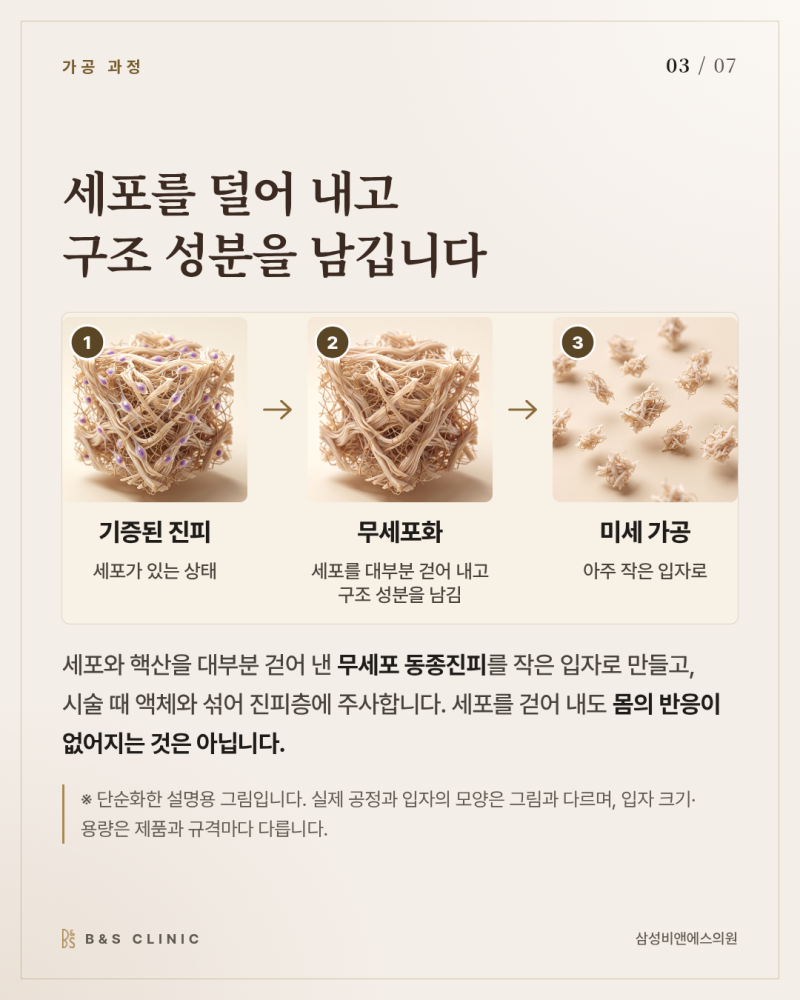
Step 01 / 03 · Donated Dermis (DONOR DERMIS)
Dermis from donated skin that has passed the screening criteria. The cells remain intact among structural components such as collagen and elastin.
Step 02 / 03 · Decellularization (DECELLULARIZATION)
Most cells and nucleic acids are removed, leaving behind the structural components that were between the cells. Dermis processed this way is called acellular allogeneic dermis (hADM).
Step 03 / 03 · Micronization (MICRONIZATION)
The acellular allogeneic dermis is ground into very small particles. Both manufacturers describe their products as finely milled acellular allogeneic dermis, and 셀르디엠 is presented as a freeze-dried powder. During treatment, these particles are mixed with a liquid and injected, mainly into the dermal layer.
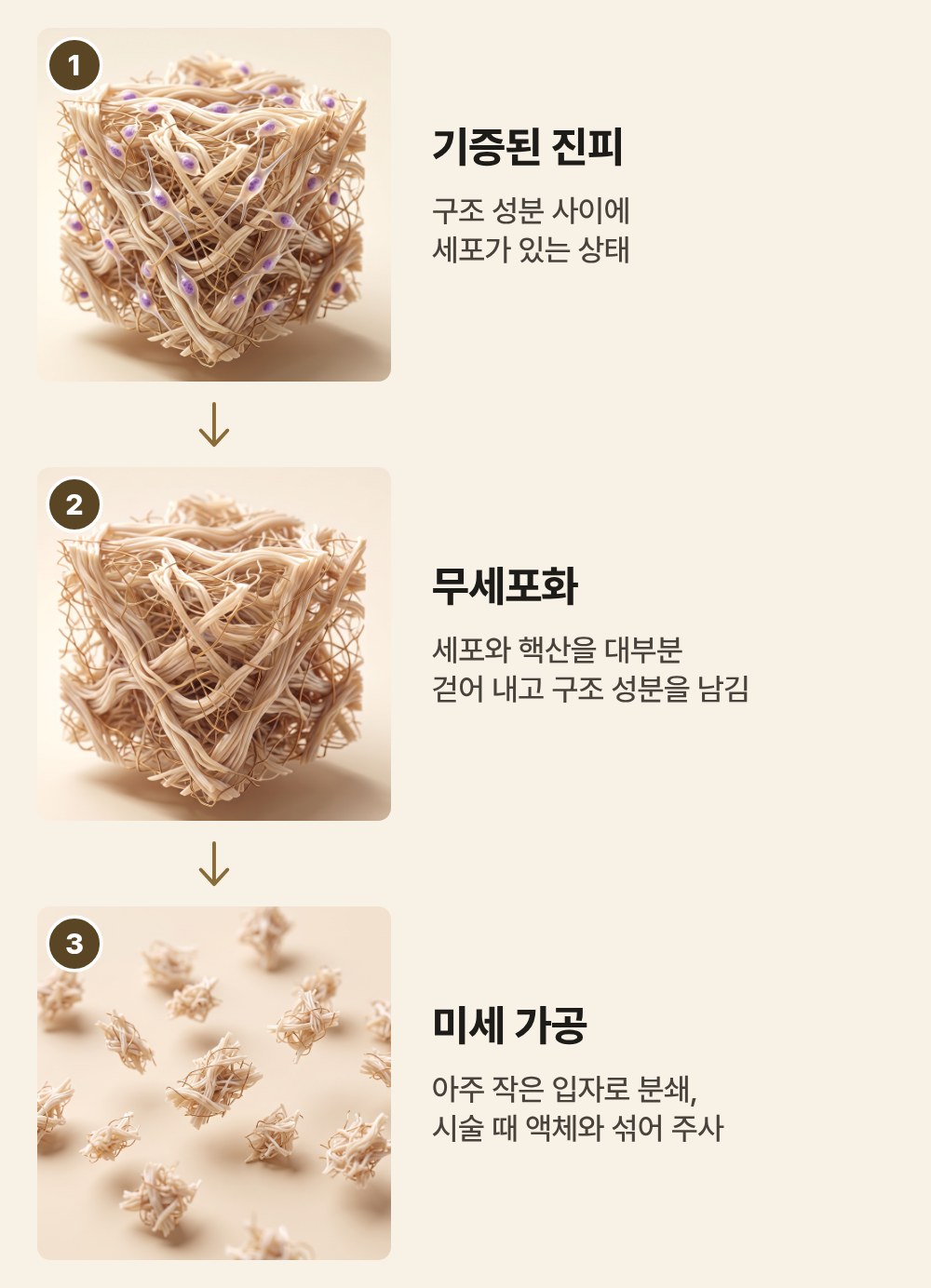
This is a simplified illustration of how raw material becomes particles for injection. The actual process and particle shapes differ from the illustration, and particle size and volume vary by product and specification. The illustration does not show the actual product.
Many details about the specific methods used to remove cells and the sterilization processes have not been publicly disclosed. It is understood that even acellular allogeneic dermis can differ in material properties and bodily response depending on the source material and processing method.
What goes into the injection is not cells, but the structural components that once sat between cells.
5. Classified as “human tissue,” not as a drug or medical device
리투오 and 셀르디엠 are managed not as drugs or medical devices, but as human tissue under the Act on the Safety and Management of Human Tissue, etc.
Drugs and medical devices are licensed only after their safety and efficacy data have been reviewed on a product-by-product basis. Human tissue follows a different approach. Tissue banks licensed by the MFDS Commissioner manage donor screening, processing, storage, and distribution, and their licenses must be renewed every three years. For this reason, describing a product as “MFDS-approved” is not accurate. What is licensed and renewed is the tissue bank as an institution; 리투오 and 셀르디엠 have not been separately reviewed and approved for their effectiveness or safety.
The law also sets requirements for packaging and records.
· Packaging — The package must bear the words “Human Tissue,” the name of the tissue bank (for imported tissue, including the overseas manufacturer), the lot number, and the expiration date. Processed tissue must be distributed sealed and cannot be reopened or repackaged for distribution.
· Package insert — Includes the country where the tissue was collected, donor test results, time limits for use after opening, and a statement that individually packaged tissue is for use in one patient only.
· Records — Tissue banks and tissue transplant medical institutions must track and record each piece of tissue from distribution through transplantation, and must report outcomes and any adverse events to the MFDS Commissioner.
Under the current system, there is no procedure for reviewing and approving cosmetic use on a product-by-product basis. At the October 2026 National Assembly audit, it was pointed out that ECM skin boosters used for cosmetic purposes need a different management framework from the current one, and the MFDS said it would revise its management system. Related standards may change in the future.
The regulatory framework that governs a product is also information you should know when choosing a treatment.
6. Same category, different manufacturers
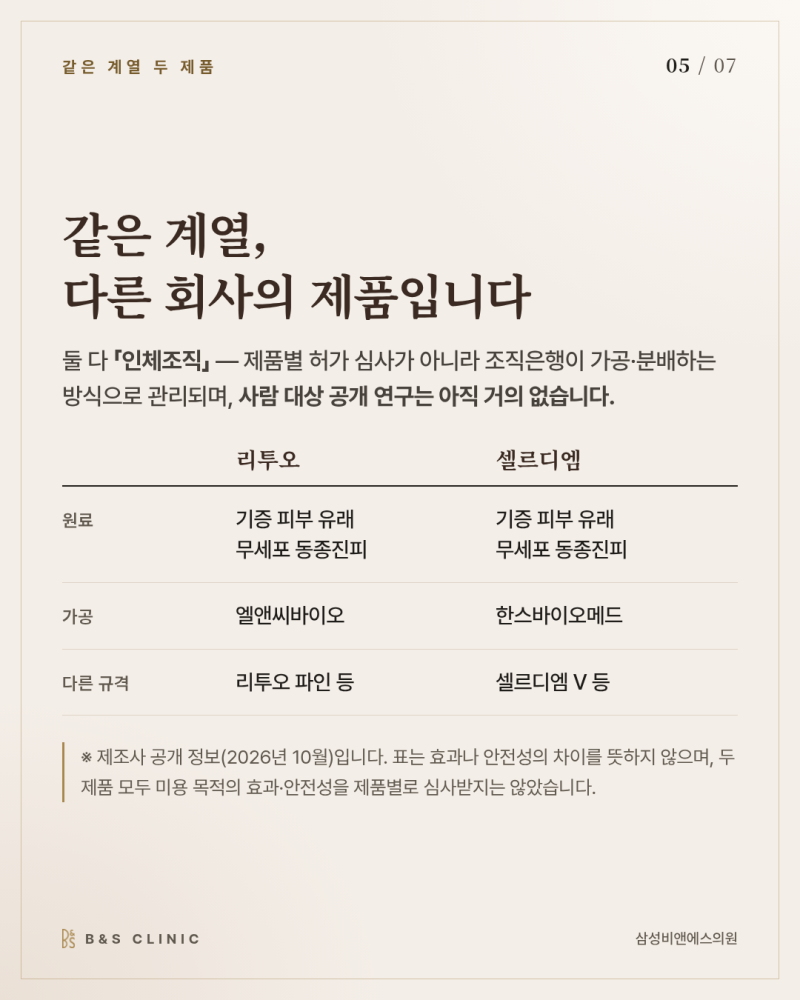
리투오 and 셀르디엠 are both human tissues made by finely processing acellular allogeneic dermis obtained from donated skin. The type of raw material and the legal classification are the same, but the manufacturing company, processes, and product specifications differ. Even within the same brand name, there are separate specifications with different particle sizes and volumes (e.g., 리투오 Fine, 셀르디엠 V).
Category | 리투오 | 셀르디엠 |
Raw material | Acellular allogeneic dermis derived from donated skin | Acellular allogeneic dermis derived from donated skin |
Legal classification | Human tissue | Human tissue |
Processed by | L&C Bio | Hans Biomed |
Other specifications under the same name | 리투오 Fine and others | 셀르디엠 V and others |
This table includes only the manufacturing and classification information disclosed by the manufacturers and in press releases (as of October 2026). The items in this table do not indicate any difference in effectiveness or safety.
7. What happens to injected ECM inside the skin?
Animal studies have observed that when ECM material is introduced into the body, it gradually breaks down over time, during which surrounding cells move into the material and the tissue is rebuilt. The rate of breakdown varies depending on the tissue the material came from and how it was processed.
However, these findings mostly come from sheet-form materials or from animals. There is still insufficient data on how long finely particulated material remains when injected into human skin, or what changes occur in the skin over that time. Acellular allogeneic dermis has been used in reconstructive surgery, but some have pointed out that this experience cannot simply be transferred to injectable cosmetic treatments.
8. What to know before and after treatment
ECM skin boosters are also injection treatments in which a needle enters the skin. After treatment, depending on the individual, swelling, bruising, redness, soreness, temporary bumpiness at the injection sites, fine flaking, and pigmentation changes may occur. These usually subside over time, but the degree and duration vary from person to person.
Please let us know right away about these changes. Palpable lumps (nodules), inflammation, infection, and hypersensitivity reactions such as allergies may occur, and there is still limited data on how often they happen. If your skin changes color, if swelling, redness, or pain does not subside over time but instead gets worse, or if the area feels hot to the touch or pus appears, please contact the clinic immediately. Because long-term data on delayed reactions is also limited, please report any changes that appear after some time has passed.
Please be sure to tell us during consultation if you have an autoimmune disease; facial inflammation or infection, or a history of keloids or hypertrophic scars; a history of severe allergy such as anaphylaxis, or a hypersensitivity reaction to medications, including local anesthetics; if you take blood-thinning medication; or if you are pregnant or breastfeeding. In these cases, treatment may need to be postponed or reconsidered. Information about recent facial treatments such as fillers, Botox, or lasers, and the type and timing of any other skin boosters, also helps us plan your care.
For about 3 to 7 days after treatment, we recommend avoiding heavy drinking, saunas, jjimjilbang (Korean bathhouses), hot tubs, and strenuous exercise. Avoid washing your face on the day of treatment and resume from the following day. Apply moisturizer and regenerating cream frequently, and be careful to protect your skin from UV exposure when going outside. Do not force off fine flakes; let them come off naturally.
What We Look at Before Treatment
During consultation
We will first ask about:
· Type of concern — Whether it is about overall skin quality, or sagging, hollowness, or fine lines
· Skin condition — Skin thickness, redness or breakouts, tendency to form keloids
· Health status — Autoimmune disease, allergies, pregnancy or breastfeeding
· Medications — Current medications, including blood thinners
· Recent treatment history — Types and timing of other skin boosters, fillers, or lasers
· Schedule — Whether you can allow time for swelling and bruising to subside
At Samsung BNS Clinic, the director physician conducts the initial consultation rather than a consultation manager. After examining your skin in person, we decide together whether and how to proceed with treatment.

Dr. Park So-hyun, Director, Samsung BNS Clinic
If you are considering ECM skin boosters
You do not need to decide on a treatment first.
Even after learning about the materials and how they are managed, we still need to confirm whether your current concern is one that a skin booster is suited to address. That is why consultations begin with an assessment of your current skin condition.
After reviewing your skin quality, sagging, volume, health status, and previous treatments together, I will explain the options you can consider now, including ECM skin boosters.
Consultation and Booking Information
Consultation request | Samsung BNS Clinic official consultation request formYou can submit a consultation request to Dr. Park So-hyun, Director. |
Phone | 02-501-4341Office hours may vary by day, so please call to confirm before your visit. |
KakaoTalk | |
Directions | 9th Floor, Samheung 2nd Building, 514 Teheran-ro, Gangnam-gu, Seoul 5-minute walk from Exit 4 of Samseong Station (Line 2) |
Website |
#ECMSkinBooster #리투오 #셀르디엠 #SkinBooster #AcellularAllogeneicDermis #HumanTissue #ExtracellularMatrix #SamseongSkinBooster #SamsungBNSClinic #DrParkSoHyun
※ This post was written by the clinic operator for the purpose of providing medical information, and does not guarantee any specific treatment outcome.
※ After ECM skin booster treatment, depending on individual condition, swelling, bruising, redness, pain or soreness, temporary unevenness, flaking, and pigmentation changes may occur, and hypersensitivity reactions such as nodules, inflammation, infection, and allergies may develop. Donated tissue undergoes testing and processing, but the possibility of infectious transmission cannot be completely ruled out, and data on long-term outcomes, delayed reactions, and the frequency of side effects remain limited. There is currently no procedure for reviewing and approving cosmetic use on a product-by-product basis.
※ The product classification, raw materials, testing standards, and labeling information presented here are general information compiled from the Act on the Safety and Management of Human Tissue, etc., the Rules on Human Tissue Safety, and publicly available manufacturer and government materials (as of October 2026). Related regulations may change.
※ The main image and the cross-section and process illustrations are explanatory graphics intended to aid understanding. They do not depict actual tissue, products, or treatment results.
※ Whether a treatment is appropriate for you, and its scope, should be determined through thorough consultation and examination with medical staff.
Frequently Asked Questions
Where do the raw materials for ECM skin boosters come from?
The raw material is derived from the dermis of donated human skin. In April 2026, the Ministry of Health and Welfare stated that raw materials for this purpose are being imported and that tissue donated in Korea is not used.
Are ECM skin boosters approved by the MFDS?
No. They are not licensed through product-by-product reviews of effectiveness and safety. 리투오 and 셀르디엠 are managed as human tissue, and the MFDS license and the three-year renewal requirement apply to the tissue bank.
Do ECM skin boosters contain cells?
No. What goes into the injection is not cells, but the structural components that once sat between cells. Most cells and nucleic acids (DNA) are removed from donated dermis, and the remaining acellular allogeneic dermis is finely ground for use. Removing cells does not mean that immune reactions or allergies cannot occur.
What reactions can occur after ECM skin booster treatment?
Depending on the individual, swelling, bruising, redness, soreness, temporary bumpiness at the injection sites, fine flaking, and pigmentation changes may occur after treatment. These usually subside over time, but the degree and duration vary from person to person.
Should I contact the clinic right away if I have these symptoms after treatment?
Yes. Please contact the clinic right away if you notice palpable lumps, inflammation, infection, allergic reactions, changes in skin color, or swelling, redness, or pain that does not improve and instead worsens.
What should I tell the clinic during consultation before ECM skin booster treatment?
Please tell us about any autoimmune disease, severe allergies or medication hypersensitivity, use of blood-thinning medication, and whether you are pregnant or breastfeeding. If any of these apply, treatment may need to be postponed or reconsidered. Information about recent facial treatments and the type and timing of other skin boosters is also helpful.