2026-11-03
Threads Used in Thread Lifts: Start with the Materials and Structure in Their Approval Documents
Mint Lift, APTOS, and Silhouette Soft are all classified as the same Class 4 facial tissue fixation thread. This guide compares their materials, structure, and approved uses.




a. Mint Lift, APTOS, and Silhouette Soft are all absorbable threads approved by the Ministry of Food and Drug Safety (MFDS) as Class 4 medical devices under the same product category, “facial tissue fixation thread.” Each product differs in its thread material, the shape of the part that grips tissue, and the intended use stated in its approval document. b. The time it takes for a thread to break down in the body and the time that changes after treatment last are not the same number. There are still few long-term studies in humans that track how long these changes persist. c. The reactions that may appear after treatment vary depending on timing. We have separated the changes you can keep an eye on from the changes you should report to the clinic right away.
Hello, I am Park So-hyun, Director of Samsung BNS Clinic.
Mint Lift, APTOS, and Silhouette Soft are made by different companies in different countries. However, when you look up medical device approval information on the MFDS website, all three are classified under the same product name.
In this article, rather than relying on marketing claims, we summarize the similarities and differences among the three threads based on what is written in each product’s approval document. We also explain how to interpret the time it takes for a thread to dissolve, and what changes to watch for as time passes after treatment.
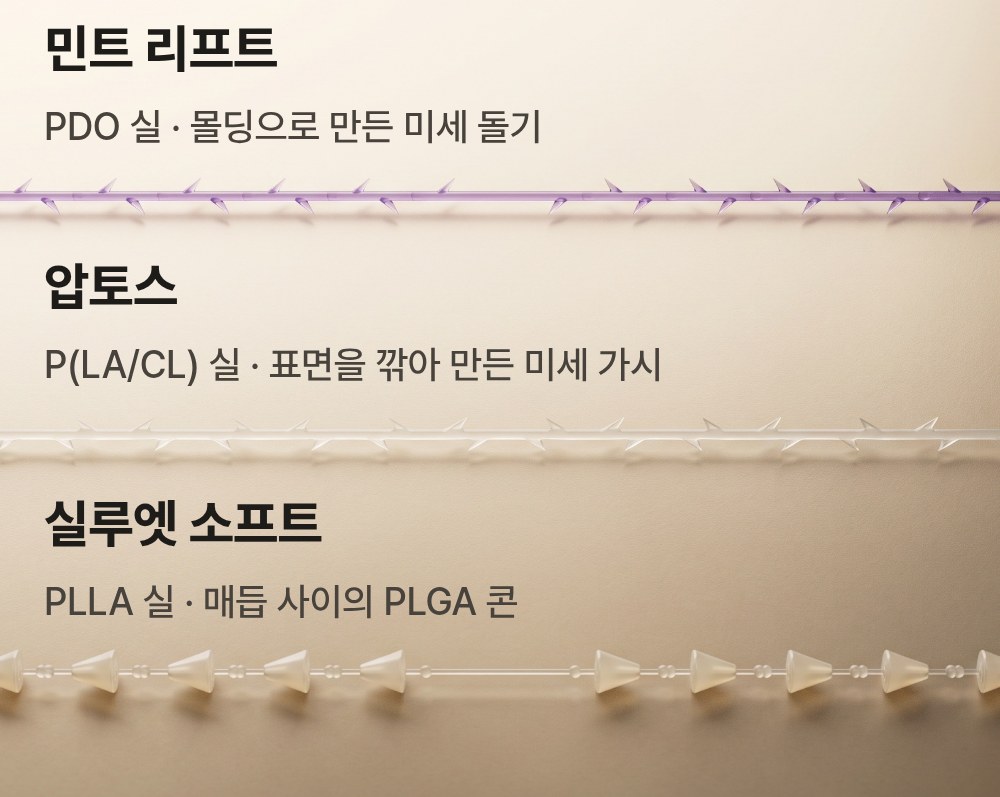
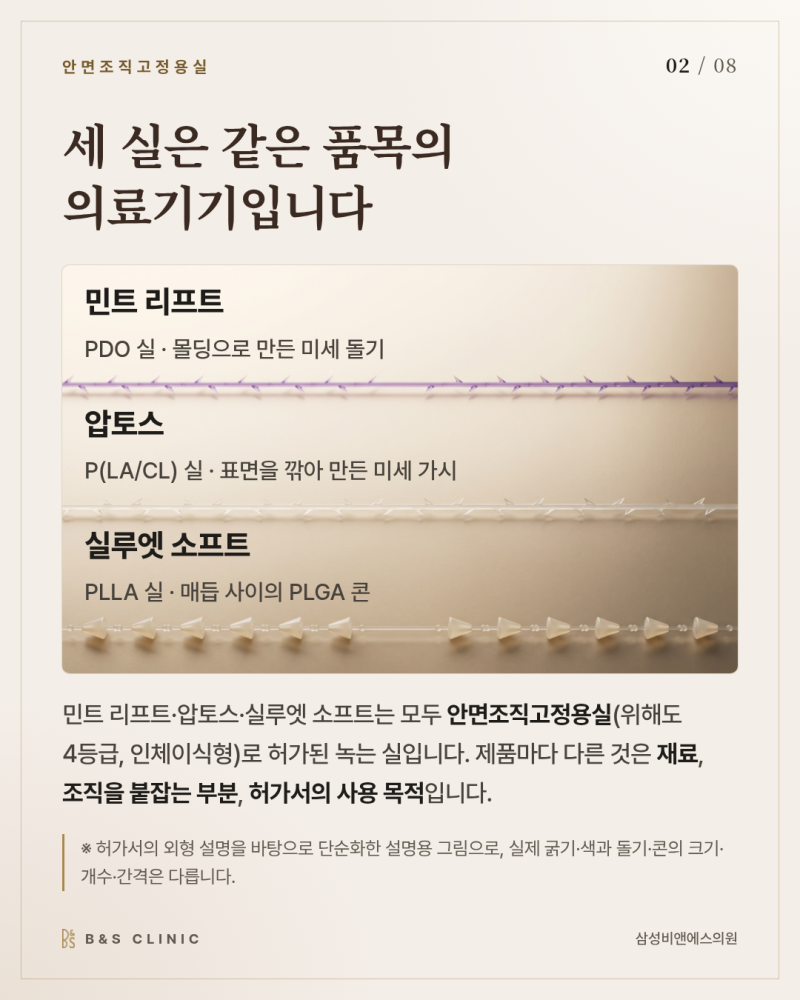
This is an illustrative diagram that simplifies the structure of the three threads based on the physical descriptions in their approval documents. From top to bottom: Mint Lift, APTOS, and Silhouette Soft. The actual thickness and color of the threads, as well as the size, number, and spacing of the barbs and cones, differ from the drawing.
1. All three threads are medical devices approved under the same product category
All three products are listed under the product name “facial tissue fixation thread.” Among medical devices classified into Grades 1 to 4 by risk level, they fall into Grade 4. Their approval documents describe them as implantable medical devices placed inside the body and as single-use devices.
All three products are made from materials that break down and are absorbed by the body over time. Within the same product category, the products differ in three ways.
· Thread material — which polymer it is made from
· Tissue-gripping element — whether it has barbs on the thread surface or cones fitted onto the thread
· Intended use in the approval document — the purpose for which approval was granted
Even if the product names differ, the approval documents list them as medical devices in the same product category.
2. The threads pass through the subcutaneous tissue beneath the skin
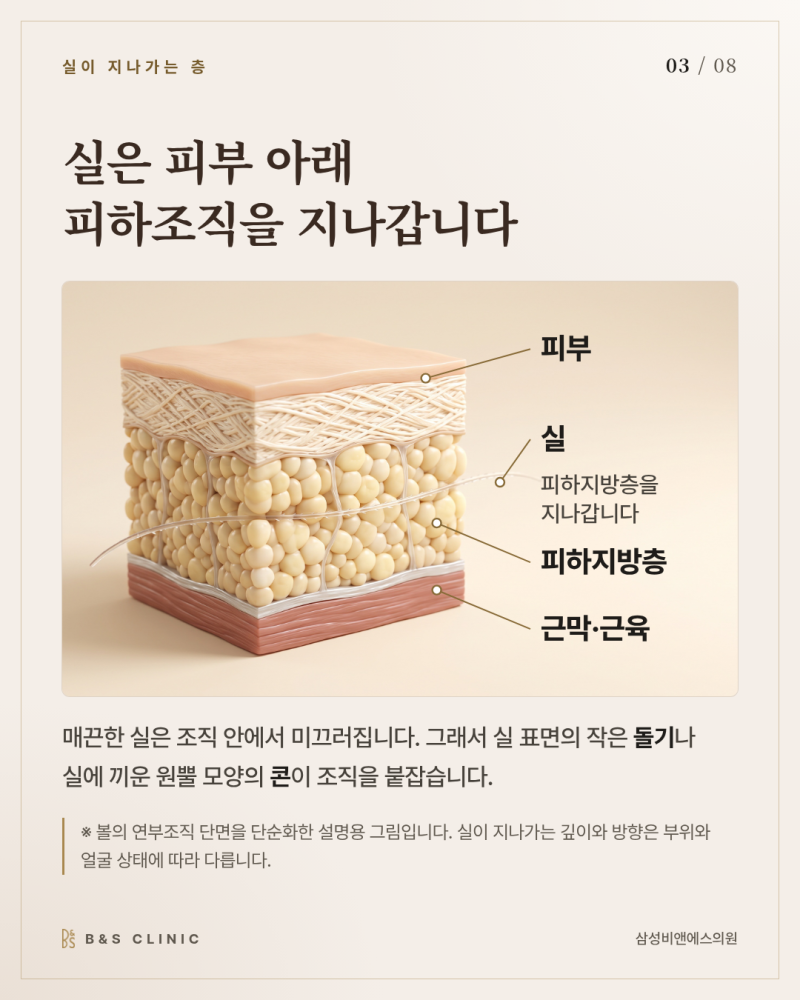
Threads used for thread lifts are inserted so that they pass through the subcutaneous tissue beneath the skin, not across the skin’s surface.
A smooth thread slides through tissue. That is why lifting threads have a part that grips the tissue. Some use small barbs that project from the thread surface and catch on the tissue, while others use small cone-shaped pieces (cones) fitted onto the thread to support the tissue.
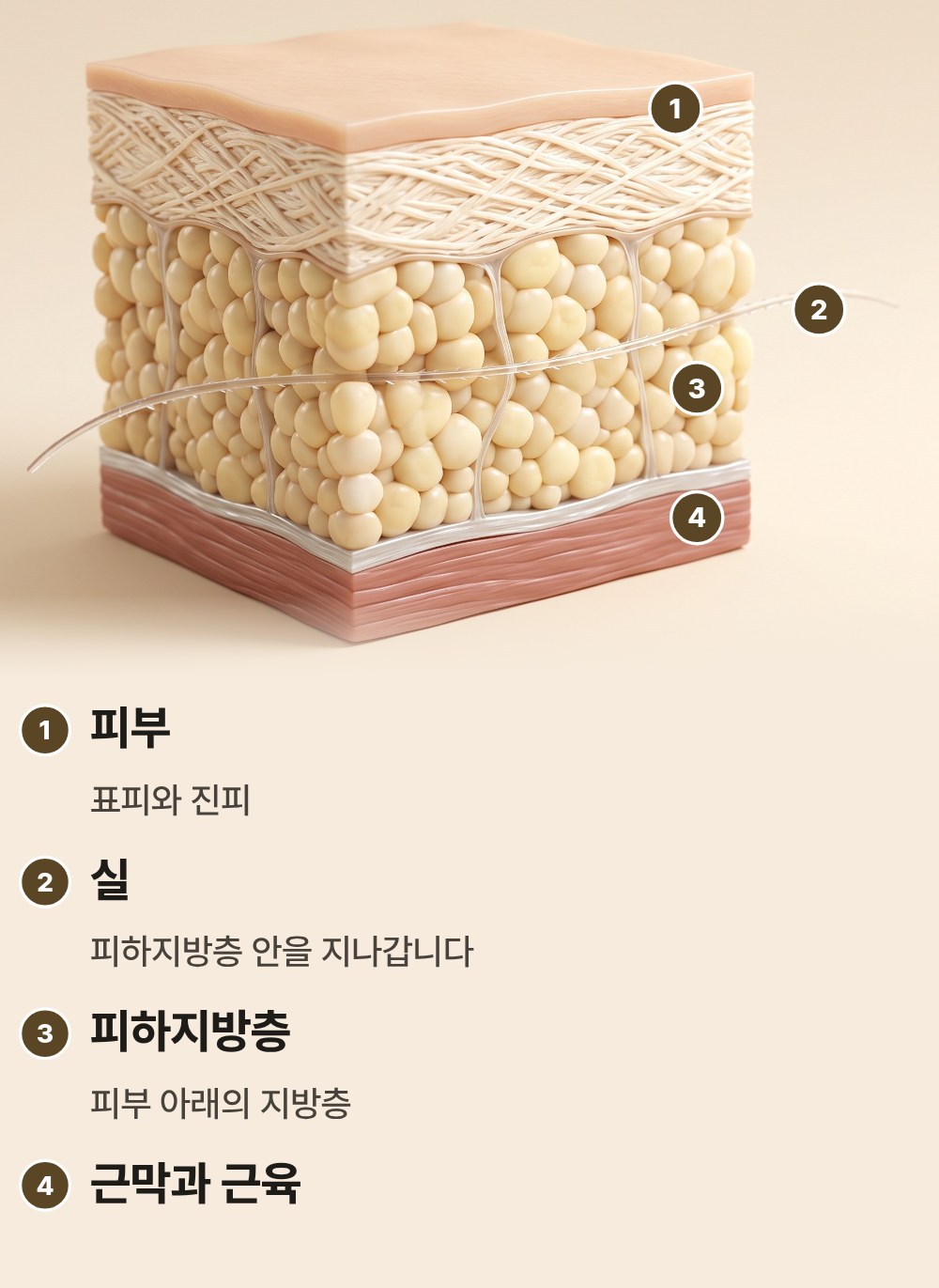
This is an illustrative diagram showing a simplified cross-section of the soft tissue of the cheek. Layer thickness and thread diameter differ from reality, and the depth and direction the thread follows vary by area and facial condition.
Barbs and cones are the parts that hold the thread in place so that it does not slide through the tissue.
3. The three threads, as read from their approval documents
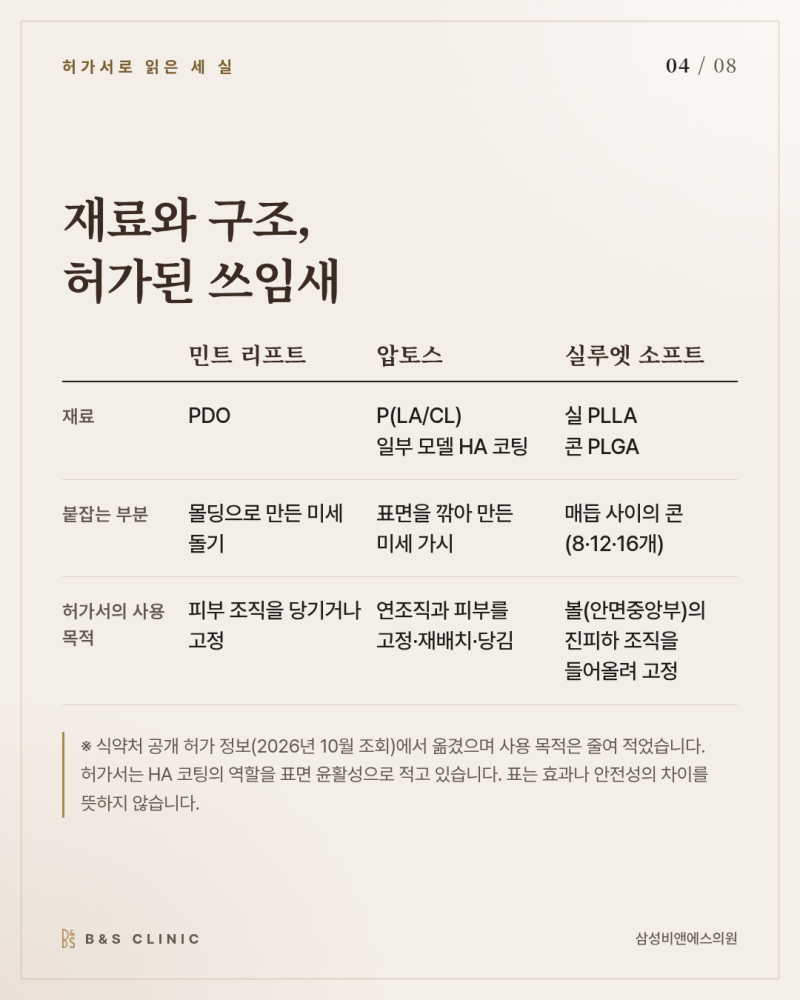
The information below is taken from each product’s approval document published by the MFDS. The intended uses are quoted word for word from the approval documents.
Product 01 / 03 · MINT LIFT
Material — A thread made of 99.9% polydioxanone (PDO) and a purple pigment.
Tissue-gripping element — Fine barbs formed by molding, a process that presses the thread into a mold, project from the thread surface. The barbs point in two directions or in multiple directions.
Intended use in the approval document — “Absorbable thread used to pull or fix skin tissue for purposes such as wrinkle improvement”
Good to know — The product should not be placed in patients undergoing treatment to prevent blood clotting or in those with a facial disease. Caution is advised for people with chronic conditions that can slow wound healing, such as diabetes or heart or lung disease.
Product 02 / 03 · APTOS
Material — A thread made of P(LA/CL), a copolymer of lactide and caprolactone. Some models have a hyaluronic acid (HA) coating.
Tissue-gripping element — Fine barbs created by cutting into the thread surface. They repeat in a symmetrical pattern pointing to the left and right.
Intended use in the approval document — “Used to fix, reposition, and pull soft tissue and skin.”
Good to know — The approval document states that the HA coating provides surface lubricity to help the thread glide smoothly through tissue. The product should not be used in patients with autoimmune diseases, blood disorders such as hemophilia, those taking anticoagulants, those with a tendency to form keloids, or those with non-absorbable injectable implants at the treatment site.
Product 03 / 03 · SILHOUETTE SOFT
Material — The thread is made of poly-L-lactide (PLLA), and the cones are made of a copolymer of lactide and glycolide (PLGA).
Tissue-gripping element — Cones are inserted between the knots on the thread, and they can move along the thread within that space. About 2 cm in the center is left empty, with cones divided on both sides. Depending on the product, there are 8, 12, or 16 cones.
Intended use in the approval document — “Used in mid-face suspension surgery (mid-face suspension surgery) to lift and fix the subdermal tissue (sub dermis) of the cheek; consists of absorbable threads and cones”
Good to know — The approved use is listed as the cheek, that is, the central part of the face. The approval document includes a warning that this procedure is not appropriate for people with extensive skin laxity or thin skin, and notes that thread ends or knots may be palpable.
This information is taken from MFDS public approval data (retrieved October 2026). Each product has several approved models, and the information above does not indicate any difference in effectiveness or safety.
Even within the same product category, the material, the tissue-gripping element, and the approved use differ from product to product.
4. The time a thread takes to dissolve and the time changes last are different numbers
When you look into thread lifts, you will often see figures like “several months.” However, these numbers often refer to three different things.
· Period during which the thread retains its strength — Test results measuring how much of the thread’s ability to hold without breaking under tension remains over time. This is usually measured in weeks.
· Absorption period — The time it takes for the thread to break down and disappear from the body.
· Duration of post-treatment changes — How long the changes visible on the face persist. This varies from person to person depending on age, skin thickness, degree of sagging, and where the thread was placed.
The performance criteria listed in the approval documents also differ from product to product in what is measured and when. Because the week at which strength is measured and the standards used for reporting differ, the figures are hard to compare directly, and some approval documents do not include any strength testing. Moreover, the time a thread remains in the body is not necessarily the same as the time the changes last.
A systematic review of thread lift studies reported that, apart from two of the included studies, the duration of the changes was not long, and that those two studies were sponsored by thread manufacturers (Gülbitti et al., 2018). A 2025 review article also noted that data on long-term effects are lacking (Riopelle et al., 2025). One analysis found that satisfaction was lower after some time had passed compared with immediately after treatment, and the researchers recommended explaining before treatment that the changes may not last long (Niu et al., 2021).
The time it takes for a thread to dissolve should not be read as the time its effects will last.
5. What we look at on your face before choosing a thread
During a consultation, we first look in the mirror together and ask what change you hope to achieve. Then we examine your face from the front, at a 45-degree angle, and from the side, and we manually move the skin and soft tissue to see where and in which direction pulling produces a visible change.
Where the sagging begins and which way it progresses determine the path and direction the thread should take. We also consider skin thickness, the amount of facial tissue, and the facial features you want to keep. If there are areas where you want to preserve volume, we factor that into the plan as well.
Thread lifts are not right for everyone. As noted above, some approval documents specify cases in which the procedure is not appropriate. An analysis that pooled multiple studies reported more skin depressions and infections in people aged 50 and older (Niu et al., 2021). For that reason, before deciding on the type of thread, we first determine whether the current sagging should be treated with a thread lift at all.
We choose the thread only after confirming the location and direction of the sagging.
6. What to watch for after treatment, by stage
Reactions after a thread lift vary by stage. The periods below are approximate guidelines. The extent and duration differ from person to person and depend on the scope of treatment and the thread used.
Stage 01 / 03 · Right after treatment to 2 weeks (FIRST WEEKS)
Swelling, bruising, pain, a foreign-body sensation, and a tight or pulling feeling may occur. These usually subside within 1 to 2 weeks, though this varies from person to person. The skin around the insertion site may look slightly depressed or uneven. If this happens, please do not press or rub the area firmly; instead, have it checked at the clinic first.
Stage 02 / 03 · Right after treatment to 4 weeks (UP TO A MONTH)
To keep the threads from loosening, we advise avoiding firm pressure on the treated area for about 2 to 4 weeks after treatment, and avoiding wide mouth opening for about 4 weeks so the threads do not shift or break. Please also avoid facial massage during this period.
Stage 03 / 03 · Several weeks to several months later (LATER)
Thread ends or knots may become palpable or visible through the skin. Reports also describe threads shifting out of position or emerging through the skin. The APTOS approval document notes that the area may become firm as the thread is absorbed. Please also tell us about any changes that appear later on.
Please contact us right away if you notice any of the following: pain, swelling, or redness that does not subside and keeps getting worse; warmth or pus when touched; a thread end visible or protruding through the skin; depressions or asymmetry that remain or worsen over time; or numbness or tingling in your face, or discomfort when making facial expressions. Inflammation, infection, and surface unevenness of the skin may not resolve on their own, so they require medical evaluation.
Our clinic’s general guidance is to avoid heavy drinking, saunas, jjimjilbang (Korean bathhouses), hot baths, and strenuous exercise for about 3 to 7 days after treatment. You may resume washing your face and applying makeup from the following day. However, the guidance varies depending on the approval document for the thread used. For example, the APTOS approval document specifies avoiding face washing for 2 days, makeup for 48 hours, sports activities for 2 weeks, heat-exposing activities such as saunas for 3 weeks, and facial massage for 1 month. Please take any prescribed medication for the period instructed, and follow the instructions you received on the day of treatment.
Changes after treatment differ by stage, and you should also tell us about any changes that appear later.
7. What you need to tell us before treatment
The approval documents for the three products specify, for each product, the situations in which the thread should not be used or requires caution. If any of the following applies to you, please be sure to tell us during your consultation.
Please be sure to tell us if you have any of the following: an autoimmune disease; a chronic condition such as diabetes or heart disease; a constitution prone to keloids or hypertrophic scars; inflammation or infection at the treatment site; an allergy to materials placed in the body; or if you take blood-thinning medication, aspirin, anti-inflammatory pain relievers, or vitamin E. Depending on the product, the thread should not be used during pregnancy or breastfeeding, so treatment may need to be withheld or postponed. Please also tell us about any previous thread lift or filler treatments, including their type and timing, and whether you have ever had non-absorbable materials placed in your body.
Frequently Asked Questions
Q. Why does the approval document list multiple models under the same product name?
Even when the product name is the same, the approval document lists several models together. Mint Lift has models with names such as FINE, PETIT, and UP; APTOS has 8 models; and Silhouette Soft has models with 8, 12, or 16 cones. Different models may have different thread lengths or diameters, or different arrangements of barbs or cones. More cones or barbs do not necessarily mean the results will be more pronounced or last longer. You are welcome to ask which model will be used before treatment.
Q. Can I have a thread lift together with other aesthetic treatments?
Some approval documents note that cases of use alongside other aesthetic procedures have been reported in the literature, while others state that the safety of combined treatments has not been officially established. If you have recently had or are planning to have fillers, Botox, laser treatments, or ultrasound or radiofrequency device treatments, please tell us the type and timing. We will decide the order and interval of treatments together during your consultation.
Q. Can I get another thread lift if threads I had placed earlier are still in my face?
Depending on the material of the previous thread and when it was placed, it may still be breaking down. Some products also specify that they should not be used if there are non-absorbable injectable implants at the treatment site. If you tell us when you had treatment, what type of thread was used, and which area was treated, we will check that along with its current condition to decide whether to proceed with another treatment.
Q. Is it okay if the area where the thread was placed still feels tight or painful a few weeks after treatment?
The area where the thread was placed, or the area near the thread ends, may feel tight or uncomfortable for some time. However, if the pain gets worse, the area becomes swollen and hot, or a thread end can be felt or seen, it could indicate inflammation or a shift in the thread’s position, so it should be checked in person at the clinic. Please do not press or massage the area yourself; contact us instead.
What we look at before the thread
During the consultation
What we ask about first
· Location and direction of sagging — where it started and which way it has descended
· Skin and tissue — skin thickness, amount of facial tissue, and the volume you want to keep
· Health status — autoimmune disease, chronic conditions, tendency to form keloids
· Medications you are taking — blood thinners, aspirin, vitamin E
· Previous treatments — types and timing of thread lifts and fillers, and any non-absorbable materials
· Schedule — whether you can allow time for swelling and bruising to subside
At Samsung BNS Clinic, the director consults with you first, rather than the consultation coordinator, and we decide together whether and how to proceed after examining your face in person.

Park So-hyun, Director, Samsung BNS Clinic
If you are considering a thread lift
You don’t need to decide on a procedure first.
Even after you understand the materials and intended uses listed in the approval documents, whether to treat your current sagging with threads needs to be assessed separately. That is why our consultation begins by identifying where the sagging on your face started.
After reviewing the direction of the sagging, your skin thickness, your health status, and any previous treatments, we will explain the options you can consider now, including thread lifts, as well as what to keep an eye on after treatment.
Consultation and Booking Information
Consultation Request | Samsung BNS Clinic Official Consultation Request Form You can submit a consultation request to Director Park So-hyun. |
Phone | 02-501-4341 Clinic hours may vary by day, so please call to confirm before your visit. |
KakaoTalk | |
Directions | 9th Floor, Samheung Second Building, 514 Teheran-ro, Gangnam-gu, Seoul Line 2, Samsung Station, Exit 4, 5-minute walk |
Website |
#ThreadLift #FacialTissueFixationThread #MintLift #APTOS #SilhouetteSoft #DissolvableThread #ThreadLiftSideEffects #SamsungStationThreadLift #SamsungBNSClinic #DrParkSoHyun
※ This post was written by the clinic operator to provide medical information, and it does not guarantee any specific treatment outcome.
※ After a thread lift, swelling, bruising, pain, a foreign-body sensation, tightness, skin depressions, unevenness, and asymmetry may occur depending on individual conditions. Thread ends or knots may become palpable or visible through the skin; threads may shift or protrude; and hematoma, inflammation, infection, allergic or other hypersensitivity reactions, sensory or motor nerve damage, damage to blood vessels or salivary glands, and hair loss may also occur. How long the changes after treatment last varies from person to person, and long-term studies supporting this are still limited.
※ The product category, materials, structure, and intended use of each product are general information compiled from the approval information published by the MFDS (as of October 2026). Approved models and details may differ from product to product.
※ The representative images and cross-sectional drawings are illustrative aids for understanding and do not depict actual products, tissue, or treatment results.
※ Whether a treatment is appropriate for you and its scope should be determined after sufficient consultation and examination with the medical team.